Showing posts with label global warming. Show all posts

Saturday, October 31, 2020

Four ways to tell: Is it news or advocacy?

I wrote this originally in 2016, but in the Trump era, it became even more important to know how to judge what is actually journalistic "news" and what is political advocacy.


When people, politicians, journalists, and others talk about "the media", everybody seems to mean something different.

For decades, "the media" referred to established mainstream news sources that pursued ethical and meticulous journalism. Today, social media has flattened the playing field and given everyone a voice, at little or no cost.  But this new "everyone" dynamic is largely made up of people who are not trained in journalism, not committed to telling all sides of a story, or are actively promoting a one-sided agenda.

How do you tell if what you come across is news or advocacy? Here are four ways:

1.  Value judgments are not attributed.

Real journalists do not tell you what they think as part of their stories.

Any time a headline or story body makes a statement about something being good or bad, admirable or not, or any other opinion, it needs to st somebody other than the journalist saying.  that means we have to attribute it as a quote or paraphrase.

If the story contains a value judgment without indicating the source, it is advocacy, not journalism.

2.  Loaded words have hidden meaning.

Journalists are trained to use descriptive language, but to avoid words that have social connotations, stereotypes, or other hidden meaning attached to them.

3. Doesn't really tell both sides of a controversy.

Advocacy thrives on giving you loaded information that is weighted to a particular agenda.  If a supposed news story brushes off an opposing point of view or only gives it lip service, it is likely not journalism.

4.   Contains ad hominem criticism, not attributed.

If the writer criticizes a person or group of people, as opposed to the person's/group's position on issues, it is a logical fallacy and it is advocacy, not journalism. Such "ad hominem" might appear in a quote and still be journalism, but when it is not attributed and this is a contention of the writer, it is not journalism.

Conclusion?

These four rules of thumb are just the beginning.  You have to scrutinize and evaluate the source of information.  Check Snopes or Politifact.  Ask yourself "is the writer promoting an agenda"?  The more you do this, the more it will become clear what is news and what is advocacy pretending to be news.


Monday, September 28, 2020

Why I Voted Against Trump in 2020


Note: I wrote this in October 2020, well before the January 6, 2021 riot and so-called insurrection in the US Capitol building. Trump's role in that fiasco is not reflected in my analysis.
     -----
I have returned my completed absentee ballots for the 2020 elections and I did not vote to reelect the president.

Conservatives like to characterize opposition to the president as "they hate Trump."


The truth is that people who are committed to voting against reelection have generally made well-thought-through decisions based on solid moral and ethical frameworks.  In addition, they're tired of the chaos, bluster, and incompetence.

For the record, I am not a member of any political party and have not been for 40+ years. I, however, have a well-developed framework of what I expect from a politician in terms of critical thinking, ethics, and public policy. My years in journalism led me to decide what I think about politicians in complex terms, judging their ethics, their words, their actions, and their behavior holistically. 

So, according to my evaluation, here are the fundamental reasons I voted against Trump.

1. Policy - I disagree with virtually every major policy position of the Trump Administration.
  • Rejection of evidence-based decisionmaking and well-established science in favor of wishful thinking or profit motive
  • Woefully mismanaging the US coronavirus response 
  • Out-of-control spending and skyrocketing deficit
  • Diverting Congressionally-allocated money to unrelated pet projects
  • Unprecedented interference with private businesses that goes way beyond OSHA, FTC and FDA norms
  • Withdrawing from the world climate agreement and WHO for petty reasons
  • Fostering fear and intimidation among legitimate refugees, a massive violation of Christian teaching
  • Trying to scale back the social safety net, as if the poor were not worthy of receiving help
  • Abandoning allies and tacitly supporting enemies of the US, in violation of all recommendations from the military and intelligence agencies
  • Encroaching on national parks and other anti-environmental decisions, in most cases to boost profits of corporate campaign contributors
  • Regressive attitudes about health care policy, as if the poor were not worthy of receiving health care
  • Interfering with military justice processes 
  • Pardoning friends who are convicted of serious crimes
  • Politicization of federal agencies that are not supposed to be political, particularly the Justice Department
  • The high-pressure rush to seat a new supreme court justice less than a month before the election, so that the justice can vote on cases he brings before the court
  • Even going to the Moon and Mars, which I like, is being forced at such a break-neck pace that safety may be compromised 
2. Management practices - No management class teaches doing things anywhere near the way Trump does, much less the prestigious Wharton School of Business at the University of Pennsylvania where he has a bachelor's degree (but no evidence of the MBA he claims)
  • Continued bungling of COVID-19 crisis communication
  • Appointing key people who have no relevant experience, or who were lobbyists for the industry they are now supposed to regulate 
  • Reliance on unqualified ACTING leadership in important positions to avoid the Congressional confirmation process; never nominating permanent replacements
  • Failure to give clear policy directives to subordinate agencies so that they misunderstand or are not properly prepared for implementation (this started almost from day one with his travel ban)
  • Undercutting coordinated policy he previously approved
  • Firing people by public tweet
  • Non-disclosure agreements for public employees
  • Failure to comply with legitimate subpoenas (which even Nixon did)
3. Morality and Ethics - We cannot tell what ethics are in the president's heart, but we can evaluate his morality (judgment of right and wrong) based on his public behavior.
  • Suppressing vital information that has led to over 200,000 COVID-19 deaths
  • Constant threats, bullying, intimidation, name-calling, insults, and general lack of civility
  • Amplifying debunked conspiracy theories
  • Constant false claims and superlatives that fail fact-checking
  • Frequent appeals to racism; encouraging hate against minority groups
  • General lack of respect toward anybody outside his inner circle
  • Using HLS (or other unidentified federal personnel) as a secret police force
  • Vindictive reprisals against political opponents
  • Profiting from his government position 
  • Intentional Hatch Act violations 
  • Anti-democratic, authoritarian tendencies (compromise is the moral foundation of democracy, not strong-man tactics)
  • Ordering violent assaults on peaceful protestors
  • Misunderstanding or deliberately disregarding the law and Constitution
  • Consuming focus on self-aggrandizement
  • Highest criminal indictment rate of political appointees in a century
  • His personal tax returns show huge ethical problems and national security vulnerabilities
4. Aptitude - Certainly, Trump came into office with no experience, but he hasn't gotten any better while in office.  The "give him a chance" argument didn't result in improvement.
  • Lack of insightful leadership on critical issues like pandemic relief and climate change
  • Little evidence of critical thinking and an apparent lack of ability to comprehend complex issues
  • Mercurial, unstable temperament 
  • Inability to stay on topic
  • Inability to articulate his ideas and policies clearly when "live" on camera
  • Inability to admit error
  • Inability to be "presidential" i.e. injecting inappropriate partisanism in situations that should be nonpartisan
  • Reliance on right-wing pundits for policy guidance
  • Wasting hours each day on "rage tweeting"
  • Almost daily conduct unbecoming a president
To be honest, I saw these things coming and did not vote for Trump the first time.  He has given me no reason to change my mind, and in fact, revalidates my original 2016 decision almost daily.


Sunday, August 19, 2018

Facts vs. Truth


Screen capture from Meet the Press, NBC
Rudy Giulaini claiming that "truth isn't truth" is so strange, but WHY it's strange has been missed by the people reacting to his comments. 

It is a tenet of conservationism that there IS an absolute truth, outside of human experience and perception, that it is fixed, and relatively easy to understand. That is where literal reading of the Bible comes from. 

Conservatives, in the meantime, are skeptical about "new" knowledge, particularly when it contradicts the established narrative. This is where climate change denial comes from. I can easily understand a conservative saying that "facts are not the same thing as truth because facts are always suspect." 

The trouble for Giulaini is that this idea goes both ways. An administration that thrives on ignoring evidence, "alternative facts", and innuendo cannot be assumed to be telling the truth. But the way that Giulaini said "truth is not truth" smacks of propaganda and "if I say it enough times, they'll believe it IS the truth." And if the truth is not the truth, it leads to a mindset that lies are not lies. 

It seems to me that we see this "truth is what we persuade people it is" mindset all the time in the bogus and easily debunked claims that float thought the advocacy media. 

That is why we NEED professional, trained journalists, whose job it is to question claims, and fearlessly seek the actual truth, among the jumble of facts and opinions. The advocacy media can't do that for us, which is why we need the professional journalistic media.


Monday, December 11, 2017

Why go to the Moon?

Going back to the Moon will be great -- if it's a means to an end and not an end in itself.

The Trump administration announced an initiative today to partner with private industry to return Americans to the Moon, and continue on to Mars.

I like the idea...if it's done right. But it could easily be done wrong.

First a confession

The starry-eyed idealist in me believes that we MUST establish a population of humans off the Earth, because there are SO many things that could destroy the Earth, or at least destroy civilization. I have thought this since I was old enough to understand the ramifications of the Cold War, and my ideas have been strengthened by the credible threats of climate change, big rocks from space, and even things like the Yellowstone super-volcano, not to mention epidemics, political stupidity, and other threats.

For the human race to insure that it will survive for the very long term, we have to distribute ourselves, in a way that is sustainable, on many different worlds, and eventually many different star systems.

Now back to today

Based on my logic above, having a significant human presence on the Moon, and eventually getting it to the point where it does not need resupply from Earth, would be a good thing. 

Having a significant human presence on MARS, and eventually getting it to the point where it does not need resupply from Earth, would also be a good thing, and possibly easier to sustain, in the long run, than the Moon.

There are other worlds in our solar system with lots of water and the possibility of sustainable colonies, as well.

Why return to the Moon now?

The biggest reason to go to the Moon now is to begin developing the technology we need to do the rest of this stuff.

A lander that can set down on Mars would also likely be able to set down on the Moon, which would be a good way to test it. The deep space outpost around the Moon, previously announced, can be the precursor of the orbit-to-orbit "mother ship" that takes people and landers to Mars, and maybe farther out.  We need to develop these things, step by step.

But we also need to start thinking not just in terms of reusable space vehicles, but also vehicles that can do lots of stuff.  Like the space opera fiction of the 1950s, our next generation of craft needs to be flexible enough to go many different places and land on many different worlds.

That's expensive, isn't it?

Yes, but the reusability brings the cost down a lot.  Partnering with private industry brings the cost down a lot.  Stable goals that do not get changed every time there is a new president would make a BIG difference. 

And remember -- every dollar spent on space is spent ON EARTH.  All the R&D and construction contracts go to companies and institutions on Earth which employ people, and have payrolls.  It would require a big push for STEM education, which would benefit lots of other technology programs and companies, also.  Face it, without the Apollo Program, you probably wouldn't have smartphones.

Is there a down side?

There is some concern that the Trump administration is pushing NASA to the Moon and Mars as a way of deemphasizing Earth resources programs and climate research.  It may be, and those programs will need protection in Congress. 

But going to the Moon, Mars, and beyond is still a wise investment in the future of the human species.


Tuesday, September 12, 2017

Understanding Weather and Climate via Chaos Theory

I am not a mathematician, but I have published in the academic press on the subject of Complex Dynamic Systems, aka Chaos Theory, which certainly applies to weather and climate. But many Americans still don't understand how interconnected everything is when it comes to weather and climate. That makes it harder for some to accept human-caused climate change.

In Chaos Theory, tiny variations can grow to have huge effects in a dynamic system.  Weather and climate are such a dynamic system.

This article from Bloomberg shows how the LACK of warmer-than-average water in the Pacific Ocean (El NiƱo) results in worst-than-normal hurricanes in the Caribbean and Gulf of Mexico. Dry air blowing dust off of Africa’s Sahara Desert also plays a role in making bad hurricanes.

We know that warmer temperatures in the Arctic can mean colder North American winters, even though it seems counter-intuitive.

But logial falacies still persist:
"It's cold today, so there can't be global warning." 
"It snowed lot today, so there can't be global warming."

"There's no way to know what the temperature was before thermometers were invented, or before they were brought to such-and-such a location."
Each of these statements shows lack of critical thinking, yet each is common. And this makes it EASY for deniers to reinforce these wrong ideas.

The motivation of the big businesses that lobby against addressing climate change is short-term profits.  Big business is SO geared to quarterly profits reports that it has trouble seeing the long-term big picture.

Sooner or later, big business will conclude that climate change is bad for business. Insurance companies are getting a reminder in the wake of the huge hurricanes in the last several days, with billions of dollars of damages the insurance companies will need to pay out.  There is only so much they can get the government to pay for.

What I have never understood is that big companies DO make long term plans to improve profits, such as building new facilities that will take years to come online. Why can't they take the same approach to reducing carbon dioxide pollution NOW to leverage for greater profits in the future.  

We know that warming of the ocean and atmosphere is resulting in a higher rate of "extreme weather events."  What we used to call "extreme" is getting closer and closer to the new normal, unless we do something about it.


Saturday, August 5, 2017

Temperatures rising! What we REALLY know about climate change.

Update: Since I wrote this, there have been more and more extreme climate events. The warming and melting of the arctic is having an increasingly powerful effect on weather farther south, from a hurricane that retained its strength and crossed overland from Louisiana to New York to freezing weather in Texas.

Here is another of my posts that explains in detail where these extreme events are coming from.

     ---

Original article:

The first half of 2017 was the second-hottest first six calendar months on record, behind only 2016.

This article notes that this is significant because this year there is no El NiƱo, which can temporarily raise global average temperatures.

That's after correcting for all the "figures don't lie but liars can figure" distractions out there, global warming is a fact and is a clear threat.

For those of you unclear about the details, here is a primer:

  • Science is about explanations that are consistent with observed facts, updated as observed facts become more and more accurate.  The most simple, straightforward explanations are the best, and when proposed explanations are tested, there needs to be broad agreement that the observed facts ARE well explained.
  • We know that the Earth is warming. Multiple independent sources of data tell us this. It may vary a bit from year to year, but the trend is upward. Within reasonable limits of error, these different independent sources agree.
  • We know that carbon dioxide is a greenhouse gas. We know that about twice as much carbon dioxide (CO2) is appearing in the atmosphere as what the Earth can take back out via natural processes. We know that industry in general, and the fossil fuel industry in particular, emits huge quantities of carbon dioxide. We know that the parts per million of CO2 in the atmosphere has been going up since the beginning of the industrial revolution.
  • We know that water vapor has significantly more effect as a greenhouse gas than CO2, but stays in the air for only a few days whereas CO2 stays for decades. We know that warmer air has more carrying capacity for water vapor and that the water vapor mostly resides in the upper atmosphere (meaning that what happens on the ground, like drought, is not particularly relevant because it is a local/regional thing). We know that water vapor concentrations at high altitudes have been climbing at a statistically significant rate. So, the warming caused by the elevated CO2 is amplified.
  • We also know that in the prehistoric past, when the temperature was sometimes higher, the CO2 PPM was also higher. We know that there are natural sources that can cause increases in CO2, notably volcanoes, but the number of volcanic eruptions and other natural sources in the last century is not consistent with the observed increase in CO2 and other less significant greenhouse gases.
  • So the question is "where is the CO2 coming from?"
  • The hypothesis that man-made CO2 is not the cause of global warming is not consistent with the facts. If man-made CO2 is somehow not a contributing factor, then where is the excess CO2 coming from? Those who would try to shrug global warming off as a "natural cycle" are not explaining anything. A "natural cycle" still has causes and effects that can be studied and understood, particularly when they are happening NOW and not in the ancient past.

To be fair, there have been attempts to suggest other causes for the climbing temperatures, but they are all over the map. There is no alternative explanation that has stood up to repeated independent testing, the way the human-produced CO2 explanation has.

So there it is. The ONLY consistent answer to the question of where the CO2 is coming from is human sources, primarily the energy industry burning fossil fuels.

It's inconvenient because solving the problem could reduce business profits for a while, but if we DON'T solve the problem, the global turmoil will also be bad for business.  Relatively modest changes now can reduce or prevent huge catastrophes in the future.


Friday, July 28, 2017

Academic Literature Visualizations

Here's an interesting resource for people who are actually interested in what the science shows about a given topic.

Open Knowledge Maps is an academic literature search engine, but it includes a visualization that categorizes the journal articles.  Click on one of the circles and it zooms in to show the specific articles.

Another nice thing is that it shows which articles are open access and therefore can be downloaded directly.

The example above (which I know is a little small to read), is a search on "Climate Change."

Because there are a lot of scholars out there who do NOT have access to research databases through university libraries, Open Knowledge Maps joins Google Scholar as a key way of exploring the academic literature to see what the peer reviewed scientific literature says.


Monday, June 5, 2017

Climate Change Skeptics aren't Skeptics

When it comes to science, skeptics are people who question beliefs as the result of scientific scrutiny.

On the other hand, people making political arguments professing skepticism about climate change are more likely to be non-scientific in how they reach their conclusions.

So what does a true skeptic conclude about human-caused climate change?


Saturday, June 3, 2017

Failure of Conservativism

The president's withdrawal from the Paris climate treaty is not just a failure of leadership.

It is a failure to be a true conservative.

So what do I mean by a true conservative and how did he fail?

Friday, May 26, 2017

Simple Thinking in a Highly Complex World

One of the defining characteristics of conservatives is that they expect things to be basically simple.  They think that once you figure out a problem, there is usually one identifiable cause, and the problem gets solved by doing one thing.  But that doesn't work out too well in a world that is highly complex, in reality.

Sunday, January 8, 2017

Rejecting Ideas we Don't Like


When we receive information that conflicts with our pre-conceived notions (as happens all the time in politics), we often struggle to avoid admitting that we may have been wrong. But how does that work, exactly, and how can we overcome this resistance in others?

Sunday, December 18, 2016

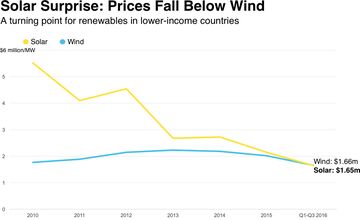
Pricing Fossil Fuels Out of the Market

Disclosed capex for onshore wind and PV projects in 58 non-OECD countriesThat article presents long-anticipated news from Bloomberg Technology that particularly in emerging markets, unsubsidized solar is less expensive than wind or fossil fuels.

Friday, December 16, 2016

Reframing the Message on Climate Change

This Scientific American article takes a while to get to the point made by its headline, but has a great call to action for liberals to shape their message to appeal to the American mainstream.

Saturday, December 10, 2016

Geese and Climate Change


The geese used to migrate in late October and early November.  Now they are migrating in December.

They have apparently bought in to the global conspiracy of thousands of scientists created by Mainland China to take money out of the pockets of hardworking billionaires.

Darn geese.

Sunday, December 4, 2016

Surprising Realities of Oil Imports and Exports


Why does American export oil at the same time it imports huge quantities?

The economics of oil crude exports and imports are strange. U.S. Oil Exports are Skyrocketing, while at the same time we import 7.3 million barrels of oil a day. Why?

Wednesday, November 30, 2016

Social Media Activism 2.0

Divided they blog" by Ladal Adamic and Natalie Glance.  By extension, 
it is an excellent representation of the current understanding of the 
"Echo Chamber" in which people online mainly interact 
with people of similar thoughts and orientations.

Political observers have noted recently that people on social media inhabit an "echo chamber" in which they only talk to themselves. As a result, no matter how much they post, they don't really change people's minds.

Yet, social media is huge in terms of selling stuff and corporations spend a fortune to influence people via social media.

How do we resolve these apparent conflicts into a paradigm for political activism via social media post-2016?

What is social media?

The idea of social networks long predates computers and smartphones.  It is "a social structure made up of people or organizations with one or more specific connection, such as friendship, family, common interests or dislikes, financial exchange, sexual relationships, and relations of belief, knowledge or prestige."

Social media is a technology-mediated social network, i.e. one pursued via electronic communications technology.

The key is that it is a network of relationships, not just information exchange.

What is persuasion?

Persuasion is "communication that is intentionally devised to influence attitudes, beliefs, or actions."  Persuasion, then, is about getting people to behave in ways you desire by appealing to their beliefs, attitudes, intentions, and motivations.

There are MANY ways to persuade (I have taught an entire semester course about persuasion). One of the most powerful, in the context of politics, is appealing to the threat/fear response. This works most effectively when the threat is personal.

How did social media fail in 2016?

To succeed, social media cannot be seen as persuading people directly to do something.  Social media needs to be seen as building relationships that will influence people to engage in a certain behavior.

In practical terms, we need to get people to do something because it is an expectation of the their reference group(s), or to support their group. Therefore, we use social media to forge and strengthen this group identify, and to present actions that align with the group.

when someone already agrees with you, this is not too hard.  When someone disagrees with you, it is much harder, and where you need to draw on psychology and established persuasion techniques.

The decision of which presidential candidate to vote for is a big, high-stakes decision.  Not many people change their minds easily about high-stakes decisions, and people HATE to change their minds, which means admitting that they were wrong.

So, how do we proceed?

We use sequential persuasion, that is, we accomplish our big goal via gaining compliance in a series of smaller persuasive steps.

We start by getting our target audience to agree to a small point that is so easy to accept and so logical that they cannot really object to it. Then we build, getting them to agree to another, and another, and another, each a logical step based on their previous agreement.

Businesses do this all the time in ways that are grounded in consumer psychology. Some typical tactics are:
  • Pre-giving – Giving "free" return address labels, meals, etc, to get you in a more receptive frame of mind.
  • Foot in the door, or a free consultation.  "We're not here to sell you anything.  We just want to understand your situation more" but in reality we are assembling evidence to use to sell you later.
  • "But wait, there’s more” – Adding allegedly free stuff that is really hidden in the price you pay.  You see this in infomercials all the time.
  • Lowball – Start with the basic version, but extol the benefits of upgrading.
  • Incremental – Provide little bits of additional information at a time.  The dozens of little revelations about governmental surveillance of citizens accomplished this. People accept it now who would not if it all came out at once.
How do we apply this in social media?

We need to apply it top-down. Hundreds of thousands of people trying in uncoordinated ways to gain compliance isn't going to work as well as centralization of the message.  The centralization needs to be based on VERY careful analysis of the mindset and world views of the people who are NOT YET part of the group.

We need to find little points that are relevant to the big issues, and frame them in ways favorable to ourselves, but also that are hard for anybody to disagree with.  Then ask readers who agree to take some easy logical action, like sharing to their friends.

When we can show that it is particularly important based on THEIR frame of reference, we can to ask them to do something bigger, like send an email or make a phone call.

What we are asking may be straightforward and obvious our in-group people, but it may be more challenging for the folks we really want to reach, who are not yet in the group.  This is because they think differently from how we think.

How do I figure out the way the other guys think?

Number one, we listen to them.  Eavesdrop on their own talk and see how they present their logic.

But as I have posted before, there is also research that can help a lot.  It shows:
  • Liberals make decisions based on data and analysis.  They are less emotional and more adaptable.  They are more likely to respond to complex information, considering multiple possibilities before making a choice.
  • Conservatives make decisions based on fear-driven emotions, emotional attachment to an idea, and group identity.  They want stability, i.e. they resist change. When faced with ambiguity, they have a strong emotional response and are more protective of assets and loved ones.  For them, stability equals predictability, equals more expected outcomes, equals less fear.  They go with the choice that seems least threatening.
  • The more conservative you are, the more group loyalty, authority, and purity/sanctity are important to you. The more liberal you are, the more harm/care and fairness are important.
To rally your base, use tactics that appeal to your own way of thinking.  To reach across party lines, you need to employ the kinds of arguments and communication styles that resonate with the other party.  This cross-party thinking can be hard to do, because it is alien to how WE think for ourselves.

If the liberals failed in their use of the "echo chamber" in 2016, it was through NOT framing the issues in ways that would appeal to undecideds (and conservatives) and in NOT employing organized, strategized calls to action.

I haven't seem much post-election change in their strategies, but maybe it is still a work in progress.


Saturday, November 19, 2016

The Counter-intuitive Truth: A warmer planet can mean colder weather


We have had our first winter storm where I live in North America.  No doubt it will result in jokes about "we just got three inches of global warming."

But when the Polar Vortex brings colder weather and more snow to northern North America, it really IS the result of a warming planet.  Here's how it works:

Warmer water in the arctic warms the air above it more than in years past.  The North Pole is currently 36 degrees warmer than usual.  The warm air rises, and it is more humid than in years past because of the warmer water.  

When it gets up high, the warmer water moves southward.  As it cools off, and gets even colder than it started because it is up to high.  Being cold, it drops down closer to the planet again, bringing colder air to the surface, where it is pulled back up north to replace the rising air.  This causes cold, humid wind to be felt farther and farther south as warmer and warmer air rises over the North Pole.

But because the planet rotates, the wind doesn't go straight south to north. It rotates around the North Pole, west to east, or counter-clockwise as you look down from above.    

This is exactly what happens with a hurricane, except that it is not at the North Pole.  Warm air rises in the middle (the Eye) and air rushes in from the sides to replace it, rotating around the eye counter-clockwise.  The way the Earth rotates, and the tidal currents, make hurricanes move.  The rotation of the Earth keeps the Polar Vortex in place, centered on the North Pole.

And THAT is how a warming planet can cause colder, snowier winters in parts of North America.  

------------------------------------------------------

Bonus note:  People who really and truly think "it's cold where I am today so the planet can't be warming" are engaging in inductive reasoning, i.e. making broad generalizations based on limited specific observations. This is a logical fallacy.   

Proper deductive reasoning requires a large number of observations (data points) to be merged into a model or framework (theory) that can be used to predict future specific observations within acceptable error.  


Friday, November 18, 2016

How to Talk to the Other Side of the Asile


This Slideshare PPT, from 2015, contains a nice analysis of how Conservatives and Liberals think.


Your brain on politics the cognitive neuroscience of liberals and conservatives

Therefore, it contains ideas to keep in mind when we are communicating with people who think differently than we do.


Saturday, November 12, 2016

Social Media is not about Advocacy


I've seen all kinds of chatter this week, second guessing the presidential election and blaming whoever they can think of for the outcome, including a hefty dose of blaming social media.  But most of this social media blaming is from people who do not understand social media.

Social media is about relationships, not about persuasion.

Social media is about relationships, not about advocacy.

Let me say it again -- social media is about relationships, which is why you are much more likely to see posts that agree with your social, political, and religious orientation.

Not quite seeing the difference?  Let's take a step back.

In the 1990s, visionaries were learning that the Internet was not simply about moving data from place to place.  It was about social relationships. Look at these two Prodigy commercials:  In 1990, it was all about stuff, but by 1995, it was about people.

Facebook and Twitter were created for the express purpose of connecting together people who already knew each other, and people who shared common interests.

When social media evolved to also be about marketing and selling you things, it drew on the fundamental principals of marketing communications, which are giving people information to which they are most likely to be receptive, and minimizing content to which people will react negatively.

This is why the Facebook newsfeed algorithm sends you news about things it believes are your interests.  In politics, this means content (news and advertising) that aligns with your political views.  Note that such advertising usually has a line at the top listing a couple of your friends who also supposedly "like" this content.

See?  Facebook is not only sending you content it thinks you favor, but it is emphasizing your relationships, in effect using your friends to make endorsements.  If you are not sure about a product or service, you are more likely to consider the product or service because people you know appear to like and endorse it.

It is your social relationships that they depend on to persuade you to consider the advertising.

Jack Wagner has pointed out that, because of the way social media works, many people who favored Trump did not really even see the opposition to him.  Many who favored Clinton never saw the opposition to her.

But even more important, they probably saw it, but did not feel any social connection to people espousing it, so discounted it.

Jim Wright observed that neither party is good at reaching out to the other side.

If progressives want to counter all of their feared Trump policy initiatives, they need to find new ways to communicate -- new ways of making contact with people who do not think the way they do, and new ways of explaining their positions in ways people who think differently can relate to.

But the real lesson here is that memes and fake news stories do not persuade people. Peer groups persuade people.  In real life and in social media.

Friday, November 11, 2016

What's next?

I was disappointed by the election results, but I could care less about second-guessing who should have done what differently.

I could care less what MIGHT happen under Trump.  All that speculation is just a distraction.

What I DO care about (as a registered independent) is whether Progressives figure out that the way they have been telling their story hasn't worked.

I DO care about whether Progressives are able to retool their system and tell their story more persuasively to people who do NOT think the way they do.

I DO care about whether Progressives are able to organize in a way they never have before to stymie policy initiatives they don't like.

Business as usual will not cut it.