Showing posts with label CO2. Show all posts

Saturday, August 5, 2017

Temperatures rising! What we REALLY know about climate change.

Update: Since I wrote this, there have been more and more extreme climate events. The warming and melting of the arctic is having an increasingly powerful effect on weather farther south, from a hurricane that retained its strength and crossed overland from Louisiana to New York to freezing weather in Texas.

Here is another of my posts that explains in detail where these extreme events are coming from.

     ---

Original article:

The first half of 2017 was the second-hottest first six calendar months on record, behind only 2016.

This article notes that this is significant because this year there is no El NiƱo, which can temporarily raise global average temperatures.

That's after correcting for all the "figures don't lie but liars can figure" distractions out there, global warming is a fact and is a clear threat.

For those of you unclear about the details, here is a primer:

  • Science is about explanations that are consistent with observed facts, updated as observed facts become more and more accurate.  The most simple, straightforward explanations are the best, and when proposed explanations are tested, there needs to be broad agreement that the observed facts ARE well explained.
  • We know that the Earth is warming. Multiple independent sources of data tell us this. It may vary a bit from year to year, but the trend is upward. Within reasonable limits of error, these different independent sources agree.
  • We know that carbon dioxide is a greenhouse gas. We know that about twice as much carbon dioxide (CO2) is appearing in the atmosphere as what the Earth can take back out via natural processes. We know that industry in general, and the fossil fuel industry in particular, emits huge quantities of carbon dioxide. We know that the parts per million of CO2 in the atmosphere has been going up since the beginning of the industrial revolution.
  • We know that water vapor has significantly more effect as a greenhouse gas than CO2, but stays in the air for only a few days whereas CO2 stays for decades. We know that warmer air has more carrying capacity for water vapor and that the water vapor mostly resides in the upper atmosphere (meaning that what happens on the ground, like drought, is not particularly relevant because it is a local/regional thing). We know that water vapor concentrations at high altitudes have been climbing at a statistically significant rate. So, the warming caused by the elevated CO2 is amplified.
  • We also know that in the prehistoric past, when the temperature was sometimes higher, the CO2 PPM was also higher. We know that there are natural sources that can cause increases in CO2, notably volcanoes, but the number of volcanic eruptions and other natural sources in the last century is not consistent with the observed increase in CO2 and other less significant greenhouse gases.
  • So the question is "where is the CO2 coming from?"
  • The hypothesis that man-made CO2 is not the cause of global warming is not consistent with the facts. If man-made CO2 is somehow not a contributing factor, then where is the excess CO2 coming from? Those who would try to shrug global warming off as a "natural cycle" are not explaining anything. A "natural cycle" still has causes and effects that can be studied and understood, particularly when they are happening NOW and not in the ancient past.

To be fair, there have been attempts to suggest other causes for the climbing temperatures, but they are all over the map. There is no alternative explanation that has stood up to repeated independent testing, the way the human-produced CO2 explanation has.

So there it is. The ONLY consistent answer to the question of where the CO2 is coming from is human sources, primarily the energy industry burning fossil fuels.

It's inconvenient because solving the problem could reduce business profits for a while, but if we DON'T solve the problem, the global turmoil will also be bad for business.  Relatively modest changes now can reduce or prevent huge catastrophes in the future.


Monday, June 5, 2017

Climate Change Skeptics aren't Skeptics

When it comes to science, skeptics are people who question beliefs as the result of scientific scrutiny.

On the other hand, people making political arguments professing skepticism about climate change are more likely to be non-scientific in how they reach their conclusions.

So what does a true skeptic conclude about human-caused climate change?


Saturday, June 3, 2017

Failure of Conservativism

The president's withdrawal from the Paris climate treaty is not just a failure of leadership.

It is a failure to be a true conservative.

So what do I mean by a true conservative and how did he fail?

Sunday, December 18, 2016

Pricing Fossil Fuels Out of the Market

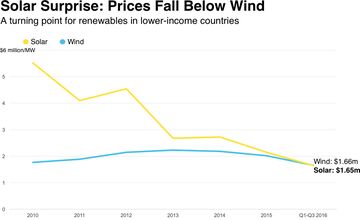
Disclosed capex for onshore wind and PV projects in 58 non-OECD countriesThat article presents long-anticipated news from Bloomberg Technology that particularly in emerging markets, unsubsidized solar is less expensive than wind or fossil fuels.

Sunday, December 4, 2016

Surprising Realities of Oil Imports and Exports


Why does American export oil at the same time it imports huge quantities?

The economics of oil crude exports and imports are strange. U.S. Oil Exports are Skyrocketing, while at the same time we import 7.3 million barrels of oil a day. Why?

Tuesday, November 1, 2016

What's REALLY going on with NoDAPL


Why are state and local government officials in North Dakota freaking out about peaceful protests against the Dakota Access Pipeline?  It's because the protesters are challenging economic development amidst a tanking state economy, plain and simple.

North Dakota “has been the economic envy of every state in America for most of the past decade” according to Bloomberg. North Dakota had the lowest jobless rate, the highest increase in personal income, and the fastest-growing population, added Bloomberg, the result of the fracked tar sands oil boom that made North Dakota second only to Texas in domestic oil production.

But as you would expect from a boom-and-bust product, the market for North Dakota oil has tried up, the state's economy has collapsed, employment has plummeted, and the state has a $1 billion budget deficit.

Finding more markets for North Dakota oil would help reverse this free-fall. That's where the oil pipelines come in. DAPL says it would create 8,000 to 12,000 local jobs across its route during construction, plus lots of on-going local tax revenue.  It is not surprising that North Dakota officials eagerly want this revenue, and officials in all four states like the idea of income that does not result from taxes on voters.

THAT is why the local authorities are so vehemently on the side of the pipeline company.

As I have said before, I believe we need to get off fossil fuels as a primary energy source.  We need to do this because we are running out, because they cause global warming, and because renewable energy is simply a good idea.

Pollution of drinking water and tribal rights are important, but there is considerably more justification to NOT build new fossil fuels infrastructure.


Saturday, October 29, 2016

Russell's Teapot and Climate Change

In 1952, Bertrand Russell wrote that when a claim is made that is not supported by science, the person making the claim has the burden to prove it. Those denying the claim do not have the the burden disprove it.

Russell was writing in the context of religion, i.e. about people believing in God even though science can neither prove or disprove whether God exists, but I have been thinking recently about how this principle works in other settings, like climate change.

Russell said that if he asserts that a teapot orbits the sun between Earth and Mars, too small to observe by any telescope, we would NOT believe him, even though there is no way to disprove that it exists.

Russell held that just because a claim has NOT BEEN disproved does not mean that it IS factual. In fact, if there is no existing way to DISPROVE an assertion, then for all practical purposes, it is NOT true, or so goes Russell's argument.

We have LOTS deniers in America today. Because a scientific finding contradicts their world view, they struggle to undermine the science, in effect to disprove the scientific assertion. Often they use logical fallacies or inductive logic (reaching general conclusions from limited small amounts of data).  They contend that there is a controversy, when there really is not.  However, THEIR assertion that there is doubt is disproved by the preponderance of evidence.

The assertion on the other side of the question is that humans are emitting the greenhouse gases that are changing the climate. Every time the assertion has been tested by a fair scientific evaluation, it turns out to be correct (within small tolerances of error).  So the only avenue available to disprove the science...has not produced evidence of disproof.

The assertion that humans are causing climate change is proved.  The assertion that the science is invalid is disproved.

Ergo, according to Russell's framework we must ACCEPT the scientific conclusion that humans are affecting the climate, and that this affect is undesirable.

Could VALID disproof be discovered in the future?  Scientists are open to new evidence that changes our understanding, but it needs to be powerful to shake the broad and persuasive current evidence, not logical fallacies.


Monday, September 26, 2016

Why Climate Deniers Deny


The study linked below used scientific analysis to examine the fallacies in arguments denying human-caused climate change.


It found that the arguments climate change are often self-contradictory and that dissent is used by stakeholders to undermine the authority of science in order to postpone inconvenient political action: 

"Climate science denial is therefore perhaps best understood as a rational activity that replaces a coherent body of science with an incoherent and conspiracist body of pseudo-science for political reasons and with considerable political coherence and effectiveness."

In other words, whereas the deniers complain loudly about a conspiracy against them, the evidence points to a dcoordinated conspiracy to ward off political action addressing global warning because they think it will be to expensive and hurt their short-term profits.

Monday, September 19, 2016

How We Solve the Problem

Wind, solar, geothermal, and tidal energies are among the solutions to global warming.
Last time I talked about what we know about climate change and global warning. Change IS HAPPENING and we need to reverse it before it reaches a tipping point that we CANNOT reverse.

The number one way to reverse global warming is to stop, or at least greatly reduce, the amount of carbon dioxide (CO2) humans pump into the atmosphere. We do this by developing and operationalizing alternative energy sources, including wind, solar, geothermal, tidal, and other energy sources.

As you see from the chart, power generation, transportation, and fossil fuel production make up nearly two-thirds of human greenhouse gas emissions, mostly CO2.  Solving the problem in those sectors would help scale back greenhouse gas production in other sectors, as well.

So, we need a policy climate in which we discourage further fossil fuel development, and promote alternative energy production.  We will likely never completely stop using fossil fuels, but we need to receive then for the most critical uses, not as the primary national energy source.

The corollary to this policy is that we need to stop building new refineries and pipelines.  You don't build expensive new infrastructure for something you need to phase out.

What else?

There are several other things we need in order to have a functional energy system for the decades ahead that is based on alternative energy and does NOT contribute to global warming:

  • Rebuild the electrical grid.  The current system (in the United States, at least) is antiquated and fragile.  It is failure-prone, and time-consuming to repair.
  • Storage capability.  The current energy system is use-it-or-lose-it.  With a few minor exceptions, there is no practical way to store energy when demand is low and retrieve it when demand is high.  California is trying, but we need a major state-of-the-art expansion so that we can even out high and low energy use times, which is more of an issue with wind and solar energy than it is with a fossil fuel economy.
We can do all of these things.  What is holding us back is rich people who think that solving this pocket will cost too much, reducing profits.  The problem with this way of thinking is that of we do NOT solve these problems, it will be even worse for business.


Sunday, September 18, 2016

Climate Change Deniers

Increased flooding is one of the most common extreme weather consequences of global warming. 

I came across the tired old arguments of climate change deniers recently, in a Facebook group as it happens.  As usual, a few folks were parroting back the usual logical fallacies like "when it's -15 degrees, nobody talks about global warming."

Actually, scientists do. Science is about explanations that are consistent with observed facts, updated as observed facts become more and more accurate.

We know that the Earth is warming. We know that carbon dioxide is a greenhouse gas. We know that about twice as much carbon dioxide is appearing in the atmosphere as what the Earth can take back out via natural processes. We know that industry in general, and fossils fuel industry in particular, emits huge quantities of carbon dioxide. We know that the parts per million of CO2 in the atmosphere has been going up since the beginning of the industrial revolution.

We know that water vapor has significantly more effect as a greenhouse gas than CO2, but stays in the air for only a few days whereas CO2 stays for decades. We know that warmer air has more carrying capacity for water vapor and that the water vapor mostly resides in the upper atmosphere (meaning that what happens on the ground, like drought, it not particularly relevant because it is a local/regional thing). We know that water vapor concentrations at high altitude have been climbing at a statistically significant rate. So, the warming caused by the elevated CO2 is amplified, reinforcing itself because the warmer air holds more water vapor, causing even warmer air.

We also know that in the past, when the temperature was higher, the CO2 in the atmosphere was also higher. We know that there are natural sources that can cause increases in CO2, notably volcanoes, but the number of volcanic eruptions and other natural sources in the last century is not sufficient to explain the observed increase in CO2 and other less significant greenhouse gases.  Similarly, the deforestation of the Amazon has reduced the ability of the planet to turn CO2 back into oxygen, but not enough to fully explain the CO2 increase.

So the question is "what is the source of the excess CO2?"

The hypothesis that man-made CO2 is NOT the cause of global warming is NOT consistent with the facts. Human industry is CLEARLY producing large amounts of CO2. If man-made CO2 is somehow not the determining factor, then where is the excess CO2 coming from?

Those who would try to shrug global warming off as a "natural cycle" are not explaining anything.  A "natural cycle" still has causes and effects that can be studied and understood, particularly when they are happening NOW and not in the ancient past.

The natural-plus-man-made CO2 is causing the planet to warm. This is disrupting long-term weather patterns.  One result is more extreme weather events.

And, yes, some places DO get colder or more snow in the winter, because shifting currents and winds take arctic air to places it has not been before.

Some thoughts about solving the problem in my next post. 

Saturday, September 10, 2016

Dakota Access Pipeline: Public Policy

© 2014 Michael Marek
In my part of the country, the efforts of the Standing Rock Tribe to oppose the Dakota Access Pipeline have been all over the news.  I know people who have been at the site on the upper reaches of the Missouri River and I support their actions.

There are serious legal questions about whether construction approvals to date has been handled properly and in ways that respect tribal sovereignty.

But there are also considerations here that many in the media, and even many who are supporting the activists, miss.


This is about the whole planet, not just Standing Rock 

Global warming is real.

About twice as much carbon dioxide goes into the atmosphere as can be processed back out by nature.

The above-ground Alaska Pipeline
People are producing that carbon dioxide, mostly from energy industry use of petroleum and coal.

Therefore, we need to stop, or radically scale back, our use of petroleum and coal.

We need to replace it with renewable energy, such as wind, solar, and geothermal power.

Ergo, we need to stop building new infrastructure that will tend to perpetuate the use of energy sources which produce waste carbon dioxide.


This is about the entire Missouri/Mississippi River watershed

The Sacred Stones Camp is on the upper Missouri River, but the combined Missouri and Mississippi River is the longest river in the world (the Missouri and Yellowstone rivers form the longest tributary of the lower Mississippi River).

Pollution of the river in North Dakota goes all the way down to the Gulf of Mexico.

The pipeline companies have been said to have "lousy leak-detection systems" and all pipelines WILL leak eventually, often with disastrous consequences.

          Freeman, SD

          Yellowstone River

True, there can be spills when oil is transported by train, but such spills are limited in geography and do not pollute thousands of miles of river used as the drinking water source for millions of people in cities along the river.


"Sacred" to a Native American is not the same as in European religions

Much has been made of claims of desecration of sacred sites of the Standing Rock tribe.  But "sacred" in Native American spirituality is different from religions that evolved in Europe.

In Christianity, generally, a place becomes sacred because of its use.  When a church, for example, is no longer used as a church, the place may no longer be considered to be sacred.

In Native American spirituality, however, a place is sacred because of its history, including its role in oral history and origin stories, and because of a people's emotional attachment.  These places do not become less sacred when the people move on. Therefore; land perceived by some to be empty or unused can still be highly sacred to a tribe

Here is a good, detailed analysis:

          American Indian Sacred Places


The oil is for other countries

Crude oil fracked out of the ground from the Bakken Fields is largely destined to be refined in the US and then shipped to other countries.  Like the Keystone XL Energy Pipeline, the oil is largely not intended for domestic American use.

So that means Americans get the earthquakes caused by fracking.

Americans get the contamination caused by crude oil spills (and fracked shale oil is the dirtiest kind of crude oil).

Americans get the pollution from the refineries.

And Americans get little or no contribution to energy independence.


Final thoughts

Everything considered, I think that supporting the Standing Rock tribe is worthy.

We SHOULD be supporting their tribal rights.

We should NOT be building new petroleum infrastructure.

We SHOULD be very concerned about toxic river pollution.

As long as we are still using petroleum as an energy source, we SHOULD conserve it and NOT ship it to other countries.