Showing posts with label Astronomy. Show all posts

Sunday, April 22, 2018

Lost in Space; Lost in Science

The new Lost in Space from Netflix is an ambitious project with likable characters, but the show runners could have benefited considerably from a science adviser.

There are a few minor spoilers below about situations, but not about the characters or story line details (unless they have already been shown in trailers).

As in the original 1960s Lost in Space, the Robinson family is on a colonizing expedition to Alpha Centauri.  This time, the Jupiter 2 is a landing craft from a larger vessel, which ends up in the wrong place and runs into trouble, requiring evacuation.

The production, based in Vancouver, uses beautiful locations and elaborate sets to produce an authentic feel.  The characters are generally likable, although they have different and more complex family relationships than in the original Lost in Space.

At face value, it is an enjoyable season with nuanced characters, a complex villain, and good action sequences, partnered with thoughtful character development.

But time and again, I was taken out of the story by having to say "that's not right" or "it doesn't work that way" about things related to science.


Ice doesn't freeze that way

Early in the series, we see a lake freeze solid in an instant, causing problems for the characters.  But water freezes at the surface first.  Yes, the script established that it was really cold, but there is liquid water under the ice on the moons of Jupiter and Saturn, not to mention probably at Pluto, which has been very cold for a long, long time.  Ice freezes by forming a thin crust of ice, which slowly gets thicker and thicker.

There are other scenes (hinted at in the trailers) in which the Jupiter 2 is also stuck in ice, and the way the ice works in those scenes doesn't seem right, either.


Forests and critters don't grow that way

Like in the original Lost in Space, the planet the Robinsons are on is in a funny orbit that will cause it to get VERY hot and pretty much kill all life.  At one point, a character notes that the trees only have one growth ring.

The life clearly has ways to recover, but the series was shot in a typical BRitish Columbia forest, with tree trunks several inches in diameter.  You are telling me that the trees get that big in one growing season?

Plus we see several indigenous animals, some of which are very large.  How do they survive the heat?

Oh, and in one scene, we see a fallen tree and stump that was clearly cut by a chainsaw.


Radio doesn't work that way

One of the main points of the overall story line is that part of the colony ship is still in orbit and and the remaining crew there is transmitting, but can not hear the landing craft on the planet, because the colony ship's dish antenna is missing.  But if you know ANYTHING about radio, this breaks down.

A broken dish antenna WOULD prevent one from receiving, but it would also prevent one from transmitting, which they were doing just fine. Plus one would not use a big dish antenna for general coverage of the entire planet, which is what the folks in space wanted.  Dish antennas are directional and the colony ship did not appear to be in a high enough orbit to be able to cover the entire planet with a tight beam dish antenna.

True, they could have been using a different omni-directional antenna to transmit, but such an antenna would also work fine for receiving signals from the surface.  Astronauts on the International Space Station use five watt portable (handheld) radios to talk to ham radio operators on Earth, transmitting through a window and using nothing but the built-in antenna of a few inches long.  Because of the altitude, and nothing in the way, it doesn't take much.

In addition, if the transmit antenna is not working right (or missing) the transmitter in the ship would not work right.  The radio operators would realize immediately that they had an antenna problem.  For purposes of talking to and from the planet, jury-rigging a replacement would not be at all hard.

Without this "the ship can't hear us" plot point, the entire rest of the story breaks down.  It is clear from the dialog that the landing ships don't have the fuel to go back into space, to save themselves from the heat, but that if the colony ship could hear them, it would send down fuel.

So the whole rationale of the ten episode story arc breaks down.


Biofuel production doesn't work that way

At one point, the folks on the planet talk about using the biowaste (manure) from animals on the planet to create fuel to power their ships.  I can't say much more, in order to avoid spoilers, but the plan is to produce huge amounts of fuel in a very short period of time, and I am not convinced that they can produce enough fuel to do what they want, starting from scratch, in the time available.


[Sigh]

I still liked the new Lost in Space and if they make a season 2, I will watch.

It has a rich production design, character-based scripts with lots of interesting character development.  It generally does a nice job of promoting the "willing suspension of disbelief" that is needed in science fiction.....

Except for these troublesome "it doesn't work that way" problems with the science part of the science fiction that significantly undercuts the story arc of the series.


Monday, December 11, 2017

Why go to the Moon?

Going back to the Moon will be great -- if it's a means to an end and not an end in itself.

The Trump administration announced an initiative today to partner with private industry to return Americans to the Moon, and continue on to Mars.

I like the idea...if it's done right. But it could easily be done wrong.

First a confession

The starry-eyed idealist in me believes that we MUST establish a population of humans off the Earth, because there are SO many things that could destroy the Earth, or at least destroy civilization. I have thought this since I was old enough to understand the ramifications of the Cold War, and my ideas have been strengthened by the credible threats of climate change, big rocks from space, and even things like the Yellowstone super-volcano, not to mention epidemics, political stupidity, and other threats.

For the human race to insure that it will survive for the very long term, we have to distribute ourselves, in a way that is sustainable, on many different worlds, and eventually many different star systems.

Now back to today

Based on my logic above, having a significant human presence on the Moon, and eventually getting it to the point where it does not need resupply from Earth, would be a good thing. 

Having a significant human presence on MARS, and eventually getting it to the point where it does not need resupply from Earth, would also be a good thing, and possibly easier to sustain, in the long run, than the Moon.

There are other worlds in our solar system with lots of water and the possibility of sustainable colonies, as well.

Why return to the Moon now?

The biggest reason to go to the Moon now is to begin developing the technology we need to do the rest of this stuff.

A lander that can set down on Mars would also likely be able to set down on the Moon, which would be a good way to test it. The deep space outpost around the Moon, previously announced, can be the precursor of the orbit-to-orbit "mother ship" that takes people and landers to Mars, and maybe farther out.  We need to develop these things, step by step.

But we also need to start thinking not just in terms of reusable space vehicles, but also vehicles that can do lots of stuff.  Like the space opera fiction of the 1950s, our next generation of craft needs to be flexible enough to go many different places and land on many different worlds.

That's expensive, isn't it?

Yes, but the reusability brings the cost down a lot.  Partnering with private industry brings the cost down a lot.  Stable goals that do not get changed every time there is a new president would make a BIG difference. 

And remember -- every dollar spent on space is spent ON EARTH.  All the R&D and construction contracts go to companies and institutions on Earth which employ people, and have payrolls.  It would require a big push for STEM education, which would benefit lots of other technology programs and companies, also.  Face it, without the Apollo Program, you probably wouldn't have smartphones.

Is there a down side?

There is some concern that the Trump administration is pushing NASA to the Moon and Mars as a way of deemphasizing Earth resources programs and climate research.  It may be, and those programs will need protection in Congress. 

But going to the Moon, Mars, and beyond is still a wise investment in the future of the human species.


Monday, August 21, 2017

The 97% eclipse (where I was)

I was not able to travel to the range of totaality, because I teach and had two classes meeting.  So I was at a place where 97% of the sun was covered by the Moon and 3% light still coming through.

Clouds covered the sun, minutes before the eclipse started:


The eclipse progressing.


And...the 3%/97% maximum, where I was:


Maybe by the 2024 eclipse I will be retired and will be able to travel further to see it.


Tuesday, August 15, 2017

The Limited Lifespan of Technological Civilizations

A recent paper in the Cambridge Journal of Astrobiology concludes that the typical
technological species becomes extinct within 500 years after attaining modern technology and that this extinction leaves the civilization's planet uninhabitable.

There is some cool information here for both my science fiction writers out there, but also for people concerned about climate change.

The paper, by retired astrophysicist and mathematics professor Daniel Whitmire, of the University of Arkansas, makes the following arguments:

1. Based on the "Principle of Mediocrity," a cornerstone of modern cosmology, when there is only one data point, we need to assume that the data is typical of other examples, even though we cannot detect them. So, in the absence of evidence to the contrary, we should believe that humans are typical of other intelligent, technological species out there in the universe. Statistically, this means we are toward the middle of the bell-shaped curve, where the vertical line is in the middle of the graphic.

2.  So...assuming we really are typical, we only know two fundamental things, a) that we are the first technological species to evolve on the Earth and b) we are early in our technological evolution.
No archaeological evidence of a previous technological civilization has been found, (Erich von Däniken doesn't count) and a true technological civilization would leave evidence that could be found for millions of years.
3.  The evolution of technological species IS statistically probable, Whitmire says, because our typical technological civilization evolved in the first 22% of the projected total lifetime of the part of Earth's biosphere suitable for land animals.  If a technological species were to be improbable, then we would expect to have evolved toward the end of Earth's biosphere lifetime, i.e beating the odds.

4.  If technological species go extinct while leaving the biosphere viable, then later technological species are likely to evolve, Whitmire says. On the other hand, if extinction leaves the land biosphere uninhabitable, the reset time could easily take too long for evolution of another technological species, he contends.

5.  Given the principle of mediocrity, which says that humans are typical of other existing technological species, and because we are early in our technological evolution, the statical likelihood is that other existing technological species we encounter will also be in the relatively early stages of technology development, and be the first to evolve on their planet.

6.  When you calculate the bell-shaped curves of probability, the best we can say, based on current evidence, is that a technological civilization is "likely" to last 500 years or less, says the author.
  • If our technological civilization survives another 1,000 years, then statistically the "likely" survival range would jump to 5,000 years or less.
  • Note that we are already 100 years into our own technological civilization.
7.  Therefore, the best evidence we have, based on the statistical principle of mediocrity, is that the typical technological species has a short lifetime and that their extinction typically coincides with the extinction of their planetary biosphere.
Note: A technological species in defined by the author as those biological species that have developed the ability to affect the global environment and utilize electronic devices. That means that one of the signature characteristics defining a technological species is invention of radio!
I said that this blog post is for my science fiction writers out there, because I think that there is some cool basis for speculative writing here.  I would also caution that it is always POSSIBLY for a civilization to be an outlier, but the ODDS say that both we, and any aliens we encounter, will be toward the center of the curve, and thus similar to ourselves.

When it comes to climate change, this logic can also serve as a basis for what we know, based on statistics, about civilizations faced with climate change and other extinction-level events. Based on the very limited statistical information we have (one data point), the likelihood is that in 400 years or less, we will make OUR planet uninhabitable.

All of this speculation is based on statistics. It is not a prediction of real world events. But it matches pretty well with the existential threats of nuclear war and climate change that our society faces. It would be nice to prove that we are NOT typical, as current defined, because we beat the odds.

This blog post was inspired by this article, but I went to the original published journal article to write my summary.


Saturday, November 19, 2016

The Counter-intuitive Truth: A warmer planet can mean colder weather


We have had our first winter storm where I live in North America.  No doubt it will result in jokes about "we just got three inches of global warming."

But when the Polar Vortex brings colder weather and more snow to northern North America, it really IS the result of a warming planet.  Here's how it works:

Warmer water in the arctic warms the air above it more than in years past.  The North Pole is currently 36 degrees warmer than usual.  The warm air rises, and it is more humid than in years past because of the warmer water.  

When it gets up high, the warmer water moves southward.  As it cools off, and gets even colder than it started because it is up to high.  Being cold, it drops down closer to the planet again, bringing colder air to the surface, where it is pulled back up north to replace the rising air.  This causes cold, humid wind to be felt farther and farther south as warmer and warmer air rises over the North Pole.

But because the planet rotates, the wind doesn't go straight south to north. It rotates around the North Pole, west to east, or counter-clockwise as you look down from above.    

This is exactly what happens with a hurricane, except that it is not at the North Pole.  Warm air rises in the middle (the Eye) and air rushes in from the sides to replace it, rotating around the eye counter-clockwise.  The way the Earth rotates, and the tidal currents, make hurricanes move.  The rotation of the Earth keeps the Polar Vortex in place, centered on the North Pole.

And THAT is how a warming planet can cause colder, snowier winters in parts of North America.  

------------------------------------------------------

Bonus note:  People who really and truly think "it's cold where I am today so the planet can't be warming" are engaging in inductive reasoning, i.e. making broad generalizations based on limited specific observations. This is a logical fallacy.   

Proper deductive reasoning requires a large number of observations (data points) to be merged into a model or framework (theory) that can be used to predict future specific observations within acceptable error.  


Sunday, November 13, 2016

Super Moon, ya, sure.


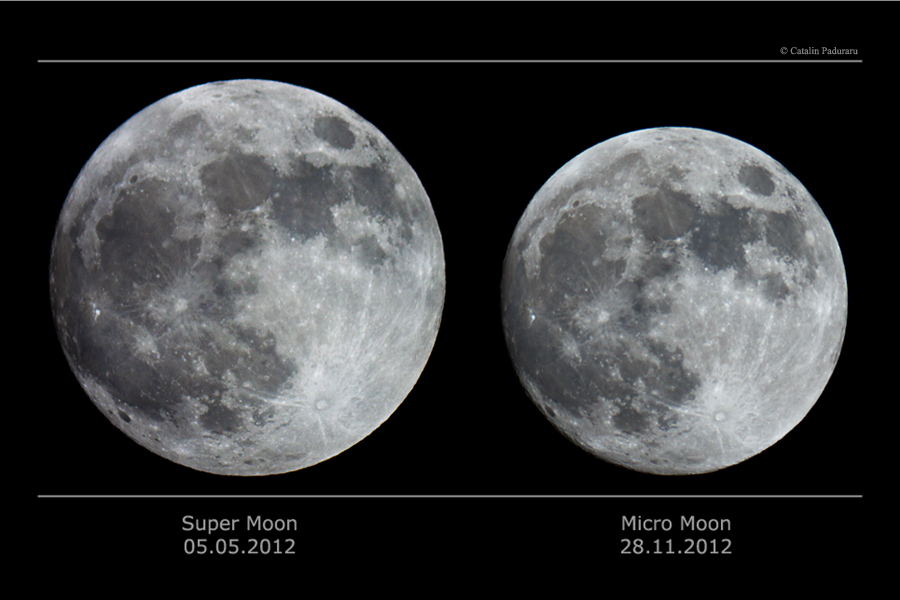
Not going out to see the imperceptibly larger than average (7%) so-called "super Moon" tonight?

This is probably my best Moon photo, from a couple of years ago.

Not Very "Super" Moon


Note that the largest the Moon ever appears in the sky is not much bigger than the smallest it ever appears.  The largest is only 14% larger than the smallest.  Average is in the middle.

Hardly anyone would notice a  "Super Moon" if not for social media.

Let's Make People Smart Again.

Image Credit & Copyright: Catalin Paduraru

Saturday, October 29, 2016

Russell's Teapot and Climate Change

In 1952, Bertrand Russell wrote that when a claim is made that is not supported by science, the person making the claim has the burden to prove it. Those denying the claim do not have the the burden disprove it.

Russell was writing in the context of religion, i.e. about people believing in God even though science can neither prove or disprove whether God exists, but I have been thinking recently about how this principle works in other settings, like climate change.

Russell said that if he asserts that a teapot orbits the sun between Earth and Mars, too small to observe by any telescope, we would NOT believe him, even though there is no way to disprove that it exists.

Russell held that just because a claim has NOT BEEN disproved does not mean that it IS factual. In fact, if there is no existing way to DISPROVE an assertion, then for all practical purposes, it is NOT true, or so goes Russell's argument.

We have LOTS deniers in America today. Because a scientific finding contradicts their world view, they struggle to undermine the science, in effect to disprove the scientific assertion. Often they use logical fallacies or inductive logic (reaching general conclusions from limited small amounts of data).  They contend that there is a controversy, when there really is not.  However, THEIR assertion that there is doubt is disproved by the preponderance of evidence.

The assertion on the other side of the question is that humans are emitting the greenhouse gases that are changing the climate. Every time the assertion has been tested by a fair scientific evaluation, it turns out to be correct (within small tolerances of error).  So the only avenue available to disprove the science...has not produced evidence of disproof.

The assertion that humans are causing climate change is proved.  The assertion that the science is invalid is disproved.

Ergo, according to Russell's framework we must ACCEPT the scientific conclusion that humans are affecting the climate, and that this affect is undesirable.

Could VALID disproof be discovered in the future?  Scientists are open to new evidence that changes our understanding, but it needs to be powerful to shake the broad and persuasive current evidence, not logical fallacies.


Thursday, September 22, 2016

Happy Autumnal Equinox.


And as we experience the equinox, harvest is beginning in my part of the world.